
Trip summary by: Natalie Carter
Arviat, Nunavut (May 23 – June 9, 2023)
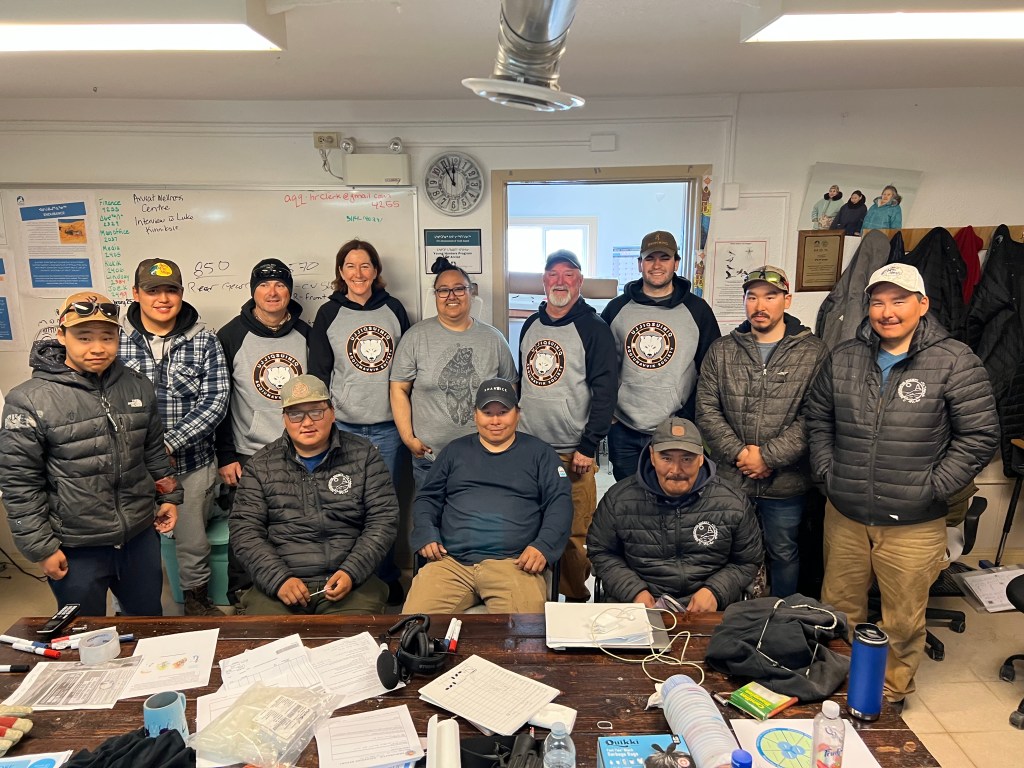
From left to right, standing: David Isluanik, Kyle Kablutsiak, Robert Bruce, Natalie Carter, Kukik Baker, Darin ‘Gator’ Walker, Owen Andrushuk, Andrew Muckpah, Alex Muckpah.
From left to right, seated: Lucas Owlijoot, Jimmy Muckpah, Zachariah Owingayak.
Missing: Joe Karetak, Ramon Kaviok, Ceporah Mearns.
All photos by: Natalie Carter and Aqqiumavvik Society
Natalie Carter (SUN Team Community Engagement Lead) and Ceporah Mearns (incoming SUN Team MA student) travelled to Arviat, Nunavut between May 23 and June 9, 2023 to work with the Aqqiumavvik Society in initiating our CIHR Goose Project. They came together with Canadian Wildlife Service staff, Young Hunters, and our Research Advisory Committee (RAC) to:
- raise awareness about project goals and progress;
- build shared definitions of goose health;
- choose the most meaningful ways to assess goose health, from a community perspective;
- refine our project evaluation framework;
- participate in a planning/training workshop about goose nesting ecology;
- conduct goose nesting monitoring in Kuugaarjuk Migratory Bird Sanctuary;
- reflect on lessons learned throughout initial field research; and,
- enjoy an Inuit cultural evening of music, stories, history, dancing, food, and friendship.
Raising awareness and building shared definitions
Aqqiumavvik Society’s Joe Karetak (Inuit Qaujimajatuqangit Research Coordinator) and Kukik Baker (Executive Director), hosted a radio call-in show to update Arviarmiut (people of Arviat) about what we are doing in this goose project. They also invited Arviarmiut to share their knowledge and experiences of goose health, and provided an overview of next steps planned for the project. Joe also hosted a half-day meeting with 4 members of our Research Advisory Committee (RAC), to update them about our project, learn about goose health indicators, and begin conversations about our evaluation framework.
Planning/training workshop
Joined virtually by Frank Baldwin (Canadian Wildlife Service, CWS), 16 project team members participated in a half-day planning/training workshop focused on goose monitoring. Topics included:
- the history of our project;
- an overview of western scientific knowledge of changes in Snow and Ross’s goose distribution and population size over time;
- clarifying our overall objective (i.e. to make sure that the goose population can be managed in a way to ensure hunting and harvesting is sustainable); and,
- refining our objectives for the upcoming goose nesting ecology research (i.e. to establish goose colony boundaries, plot measurements, and nest and egg measurements to estimate the goose population around Arviat).
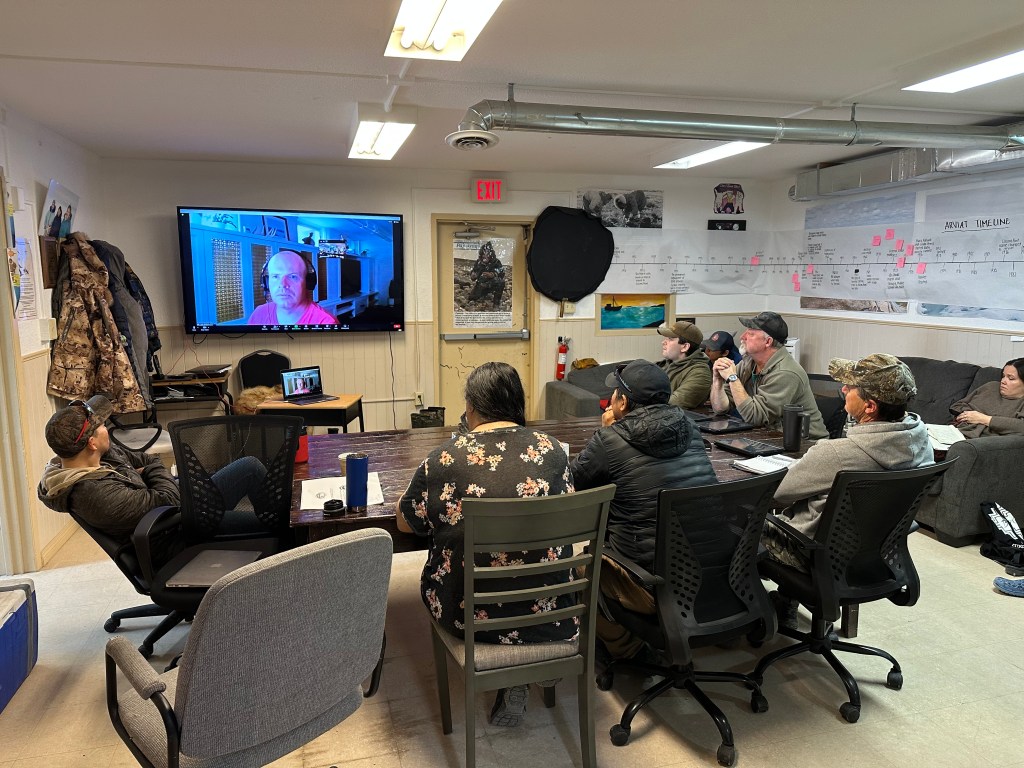
Experienced Aqqiumavvik Society and CWS staff shared their knowledge about ways to do the research, and then the team made decisions together to refine monitoring and sampling protocols. We also discussed how the results of the research would be used: notably, that the entire group gathered would have access to the information, and we would meet in fall 2023 to look at the results together.
Later the same day, Billy Nicoll (Arctic Eider Society) joined the workshop to walk us through a hands-on demonstration of using the SIKU app to record goose monitoring observations. This involved instructions on creating new posts, entering observations, tagging groups, and adding photos, as well as how to access the information once it was collected.
Goose monitoring in Kuugaarjuk Migratory Bird Sanctuary
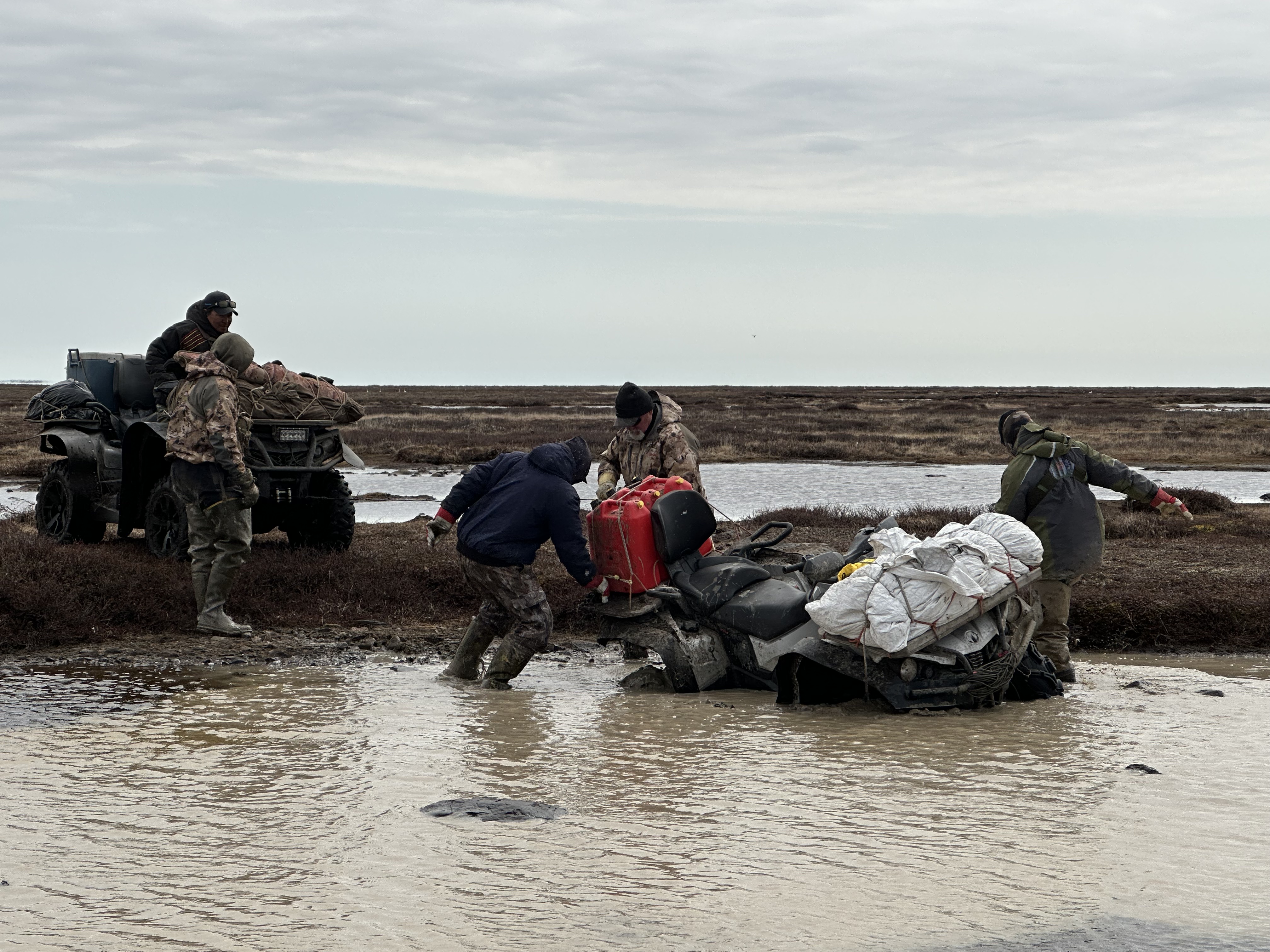
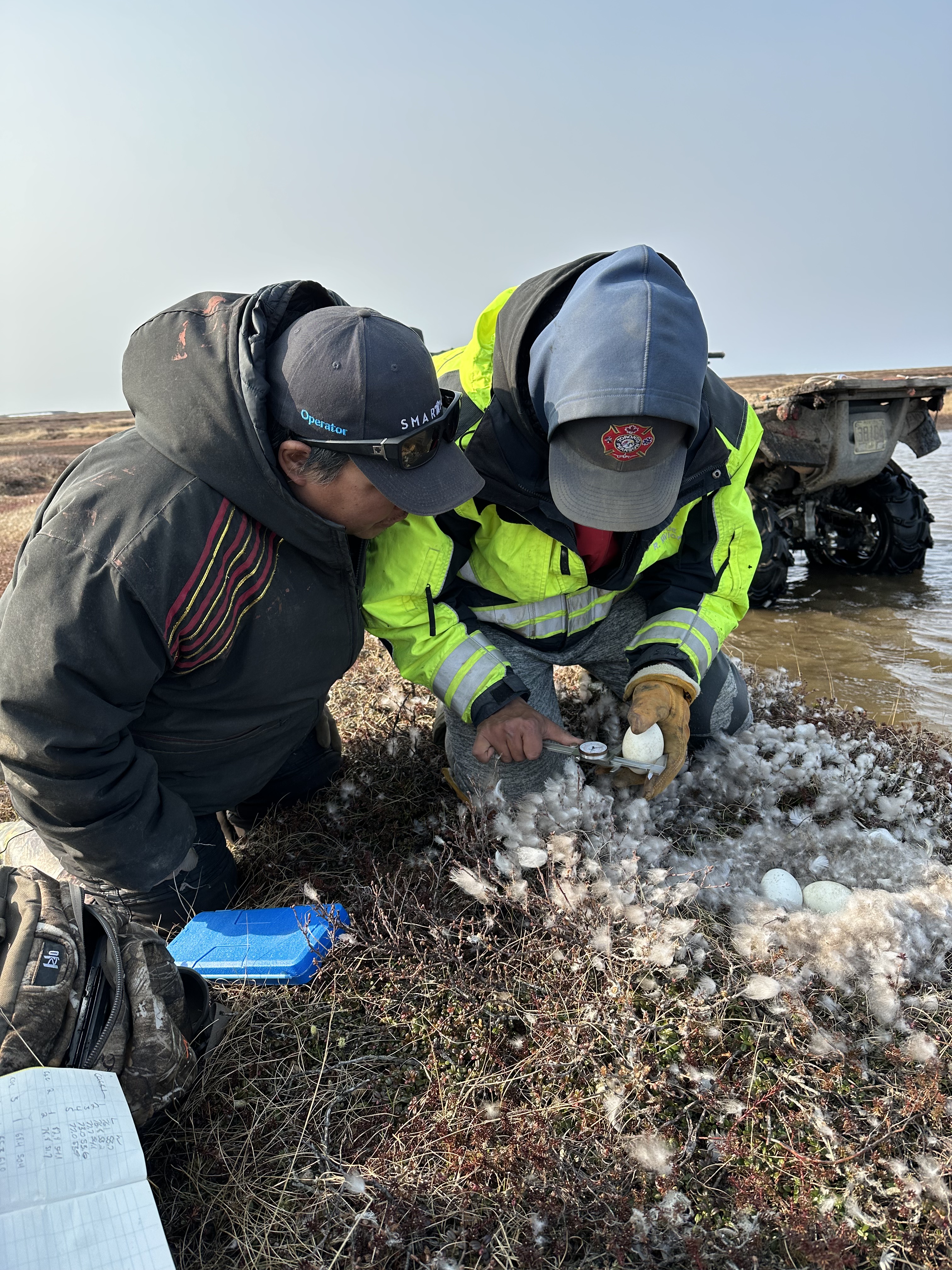
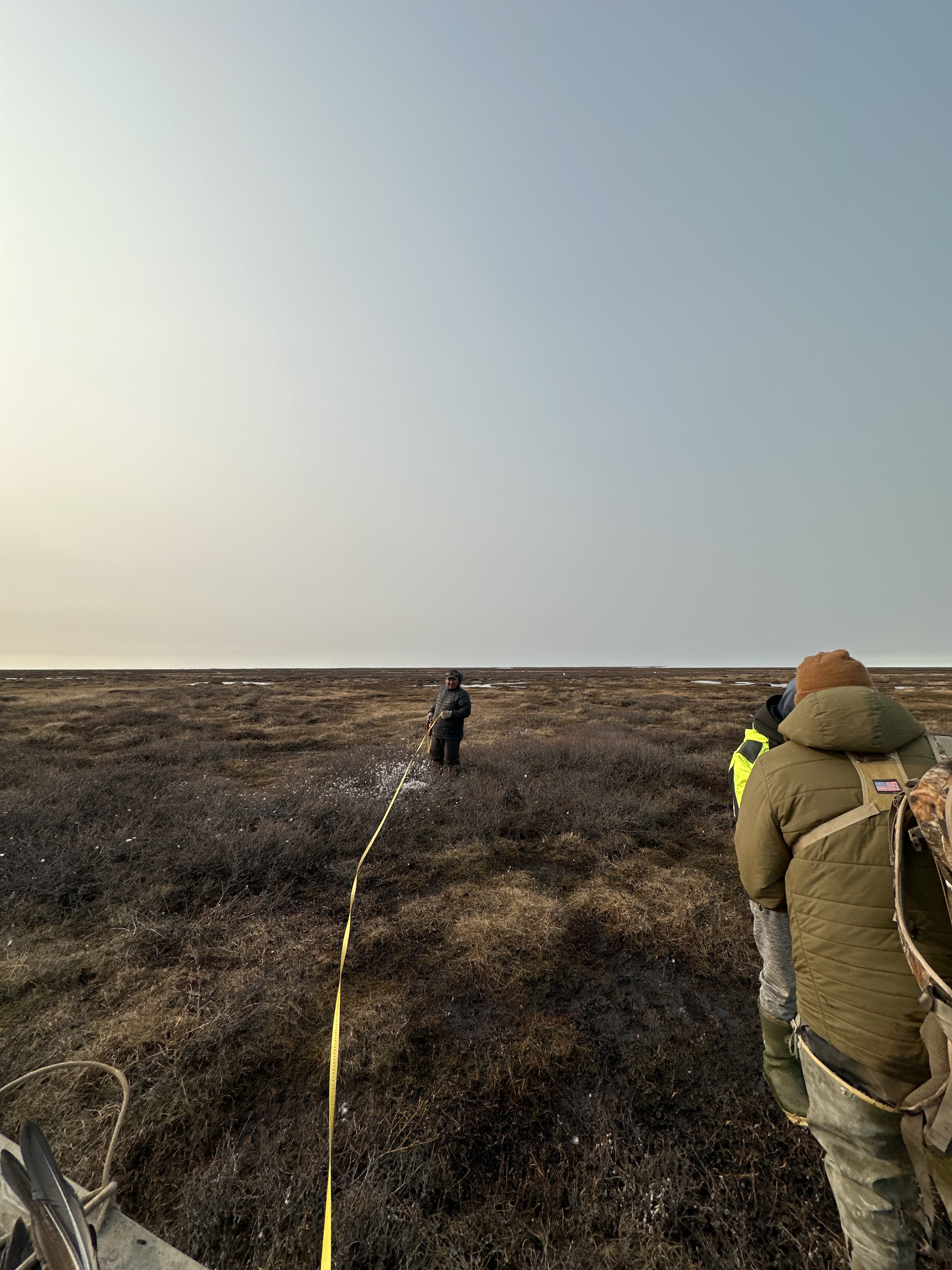
The following weekend, 11 Project Team members (4 Aqqiumavvik Society, 3 Young Hunters, 3 Canadian Wildlife Service, 1 McMaster University) conducted goose nesting monitoring in Kuugaarjuk Migratory Bird Sanctuary (MBS). The MBS, located a few hours drive (by ATV) south of Arviat, is an important breeding area for Snow and Ross’s Geese. Much of the MBS is coastal tidal flats, it is low, and does not drain well. The land is very rough and wet to travel though, causing team members’ ATVs to get stuck many times in deep mud, especially when crossing small creeks and ponds. Working together, with the help of winches and elbow grease (hard work), team members got the ATVs free, every time.
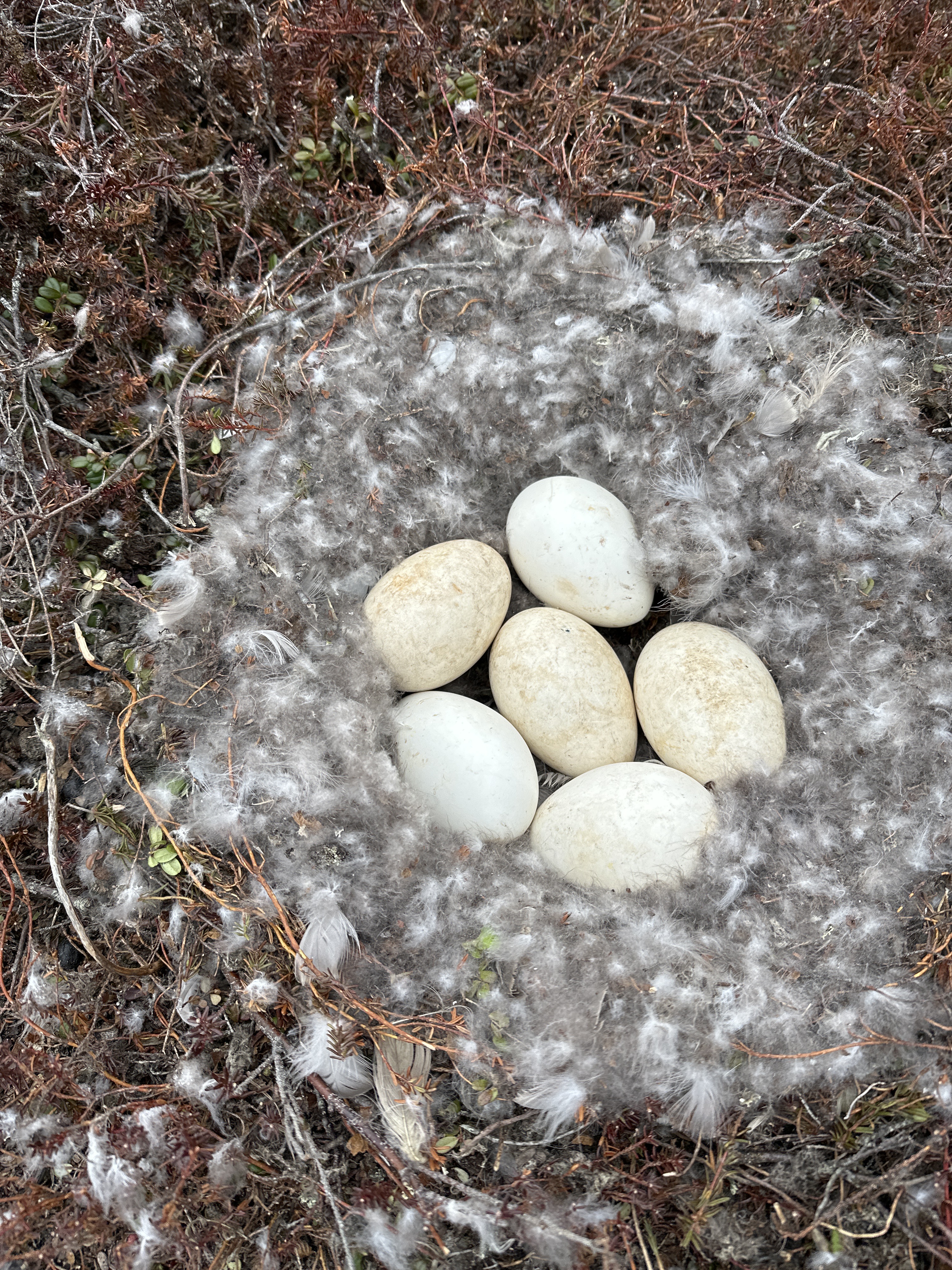
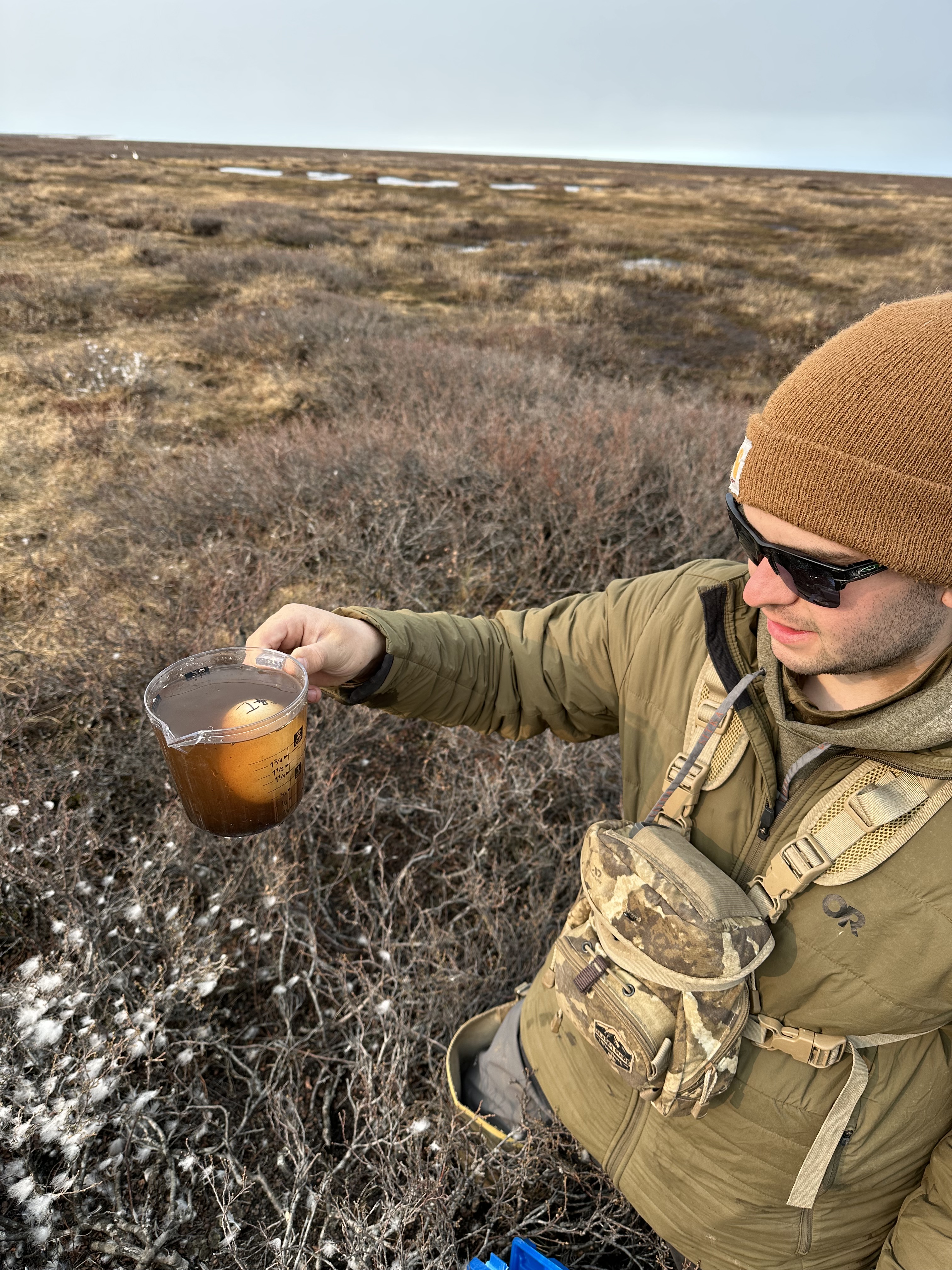
At the MBS we determined the boundary of the Snow and Ross’s goose colony, and then conducted systematic plot surveys. This involved setting up the sampling area, plotting locations, and training in field methods. We visited systematically spaced plots, and using a long tape measure we counted each nest within a 30-metre radius of a point. We measured one egg from each nest to differentiate Ross’s Geese from Snow Geese. We entered our observations into SIKU, kept handwritten notes on waterproof paper, and took GPS co-ordinates.
We stayed overnight at a base camp on an esker (hill) overlooking the goose colony. Some slept in tents and others in a cabin placed there in the early spring by Aqqiumavvik Society staff, falling asleep and waking up to the calls of geese.



Co-developing an evaluation framework
Building on ideas raised by the RAC, Joe, Kukik, and Natalie began refining our project evaluation framework. It was emphasized that the evaluation needed to be grounded in Inuit Qaujimajatuqangit principles, in particular the 4 Maligarjuat (big laws): 1) Working for the common good; 2) Being in respectful relationship; 3) Maintaining harmony; and 4) Continually planning and preparing. Developing a framework (and continually refining it throughout the project), is important to guide us as we evaluate our research process, capacity and relationship building.
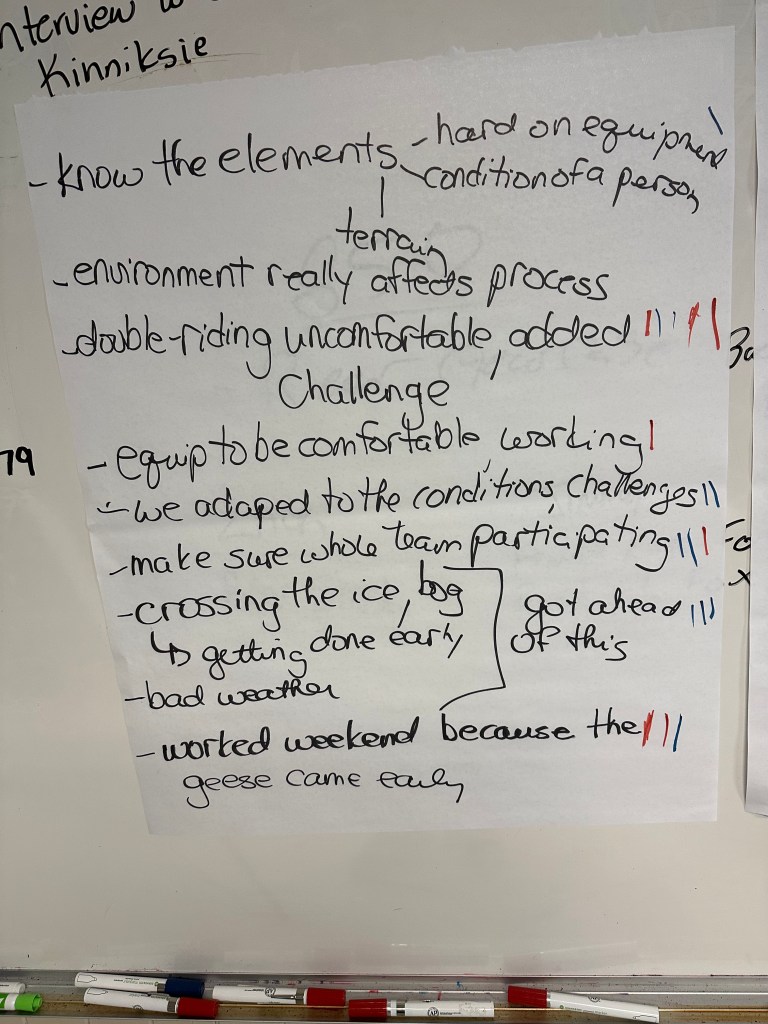
A couple of days after returning from the MBS, part of our initial evaluation involved gathering to reflect on our time on the land. Facilitated by Kukik and Natalie, we brainstormed a list of goals, challenges, and accomplishments. We each then rated the goals according to those we felt we did well (by putting a mark in red marker beside that goal), and those needing improvement (by putting a mark in blue marker beside that goal). Then we discussed as a group our experiences as we worked to achieve each goal, the steps we took to achieve it, and what we learned along the way that we could incorporate into future monitoring activities and trips.
An Inuit cultural evening
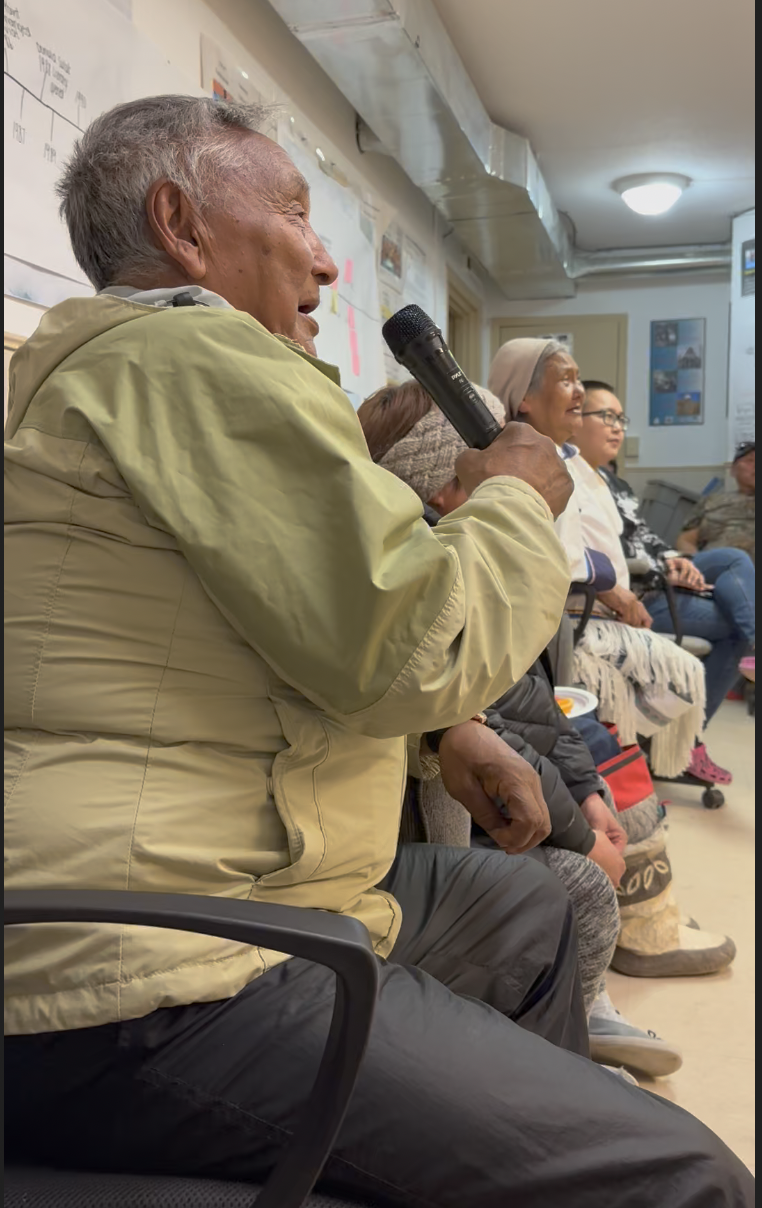
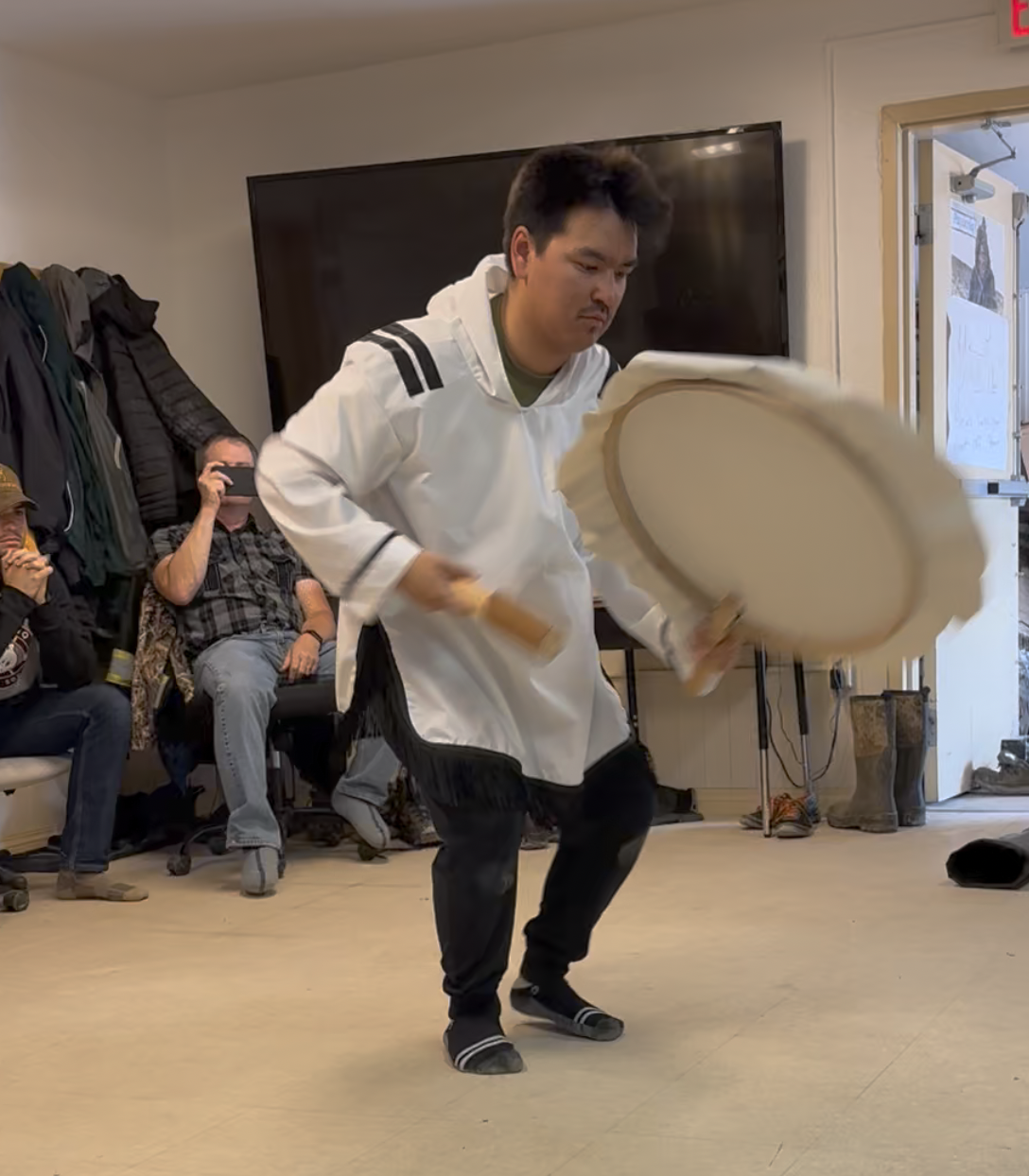
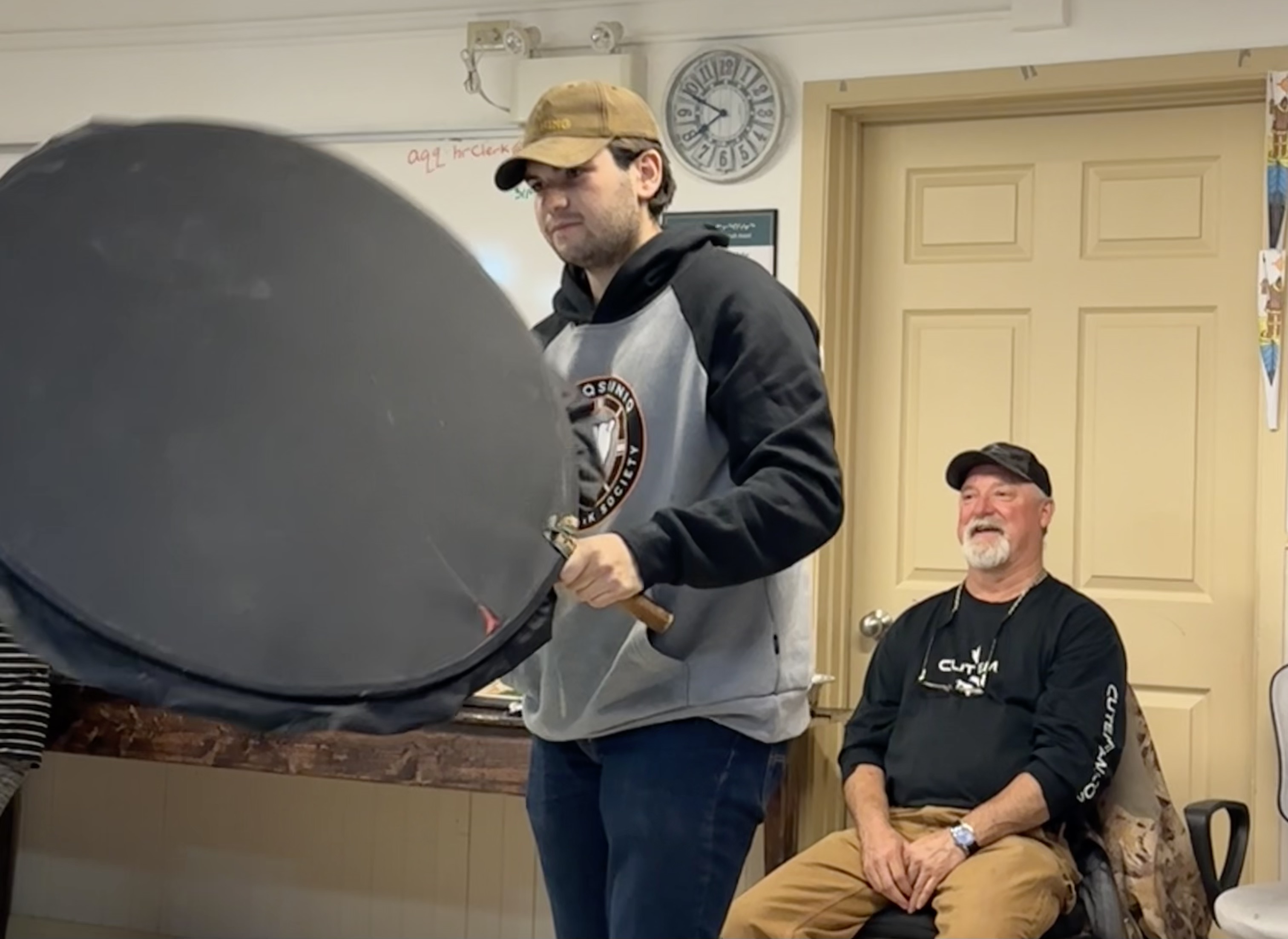
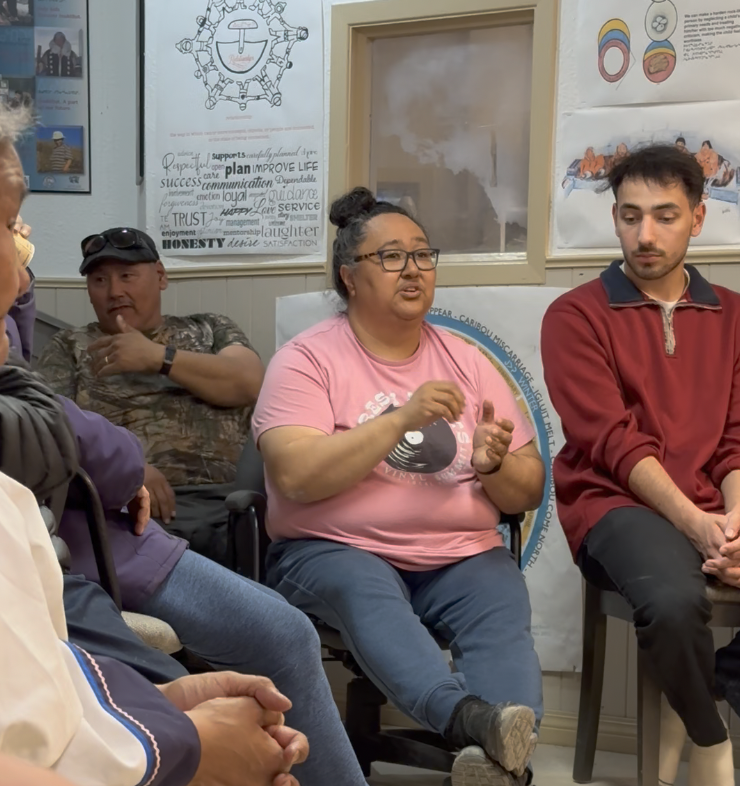
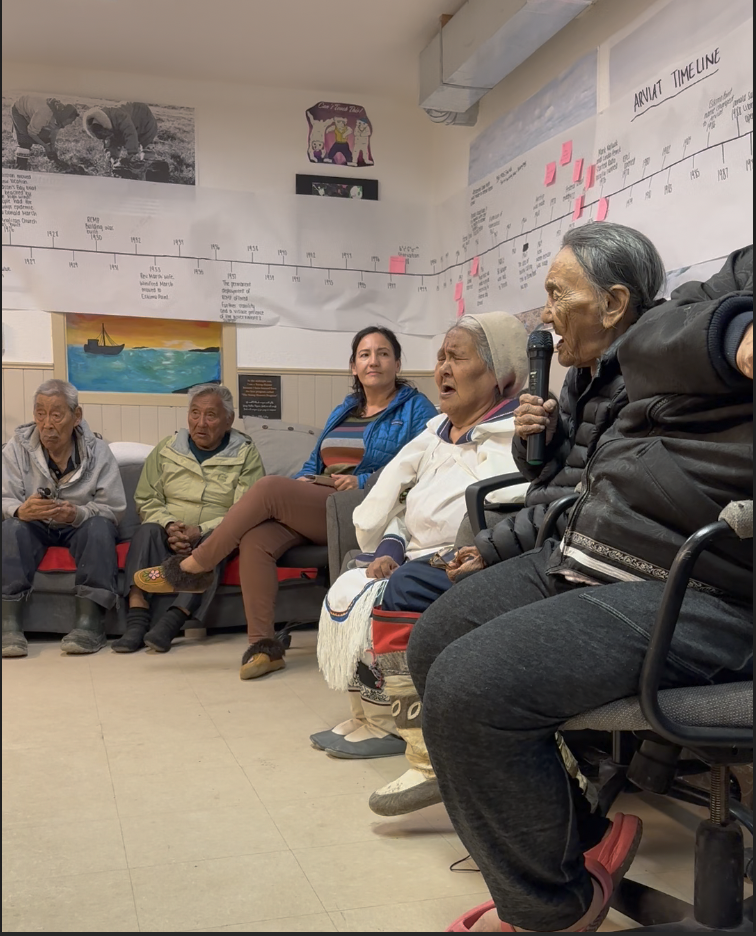
To conclude our time together, Kukik, along with Shelton Nipisar and Elizabeth Irkok from the Aqqiumavvik Society, hosted an evening with Elders, Aqqiumavvik staff, community members, and visiting team members. Everyone had an opportunity to join in singing Inuit songs, play games, drum dance, experience throat singing, and hear stories about the history of Arviat and the people who live there. Through sharing stories, music, food, a few tears, and much laughter we created wonderful memories while gaining new knowledge and perspectives. It was a wonderful way to wrap up our time together, strengthening relationships through shared experiences.
Matna
Thank you to Kukik Baker, Joe Karetak, and all the Aqqiumavvik Society’s staff, Young Hunters, and Elders who generously welcomed and hosted the visiting team members while in Kuugaarjuk Migratory Bird Sanctuary and in Arviat. Thank you to Shelton Nipisar for help with communications as he interpreted between English and Inuktitut. Thank you to Shirley Tagalik for opening your home to Natalie and Ceporah, and to all those in Arviat who so warmly welcomed us and shared their time with us.
Thanks to all in the project team for dedicating your time and effort, to make this project so meaningful, and the outcomes so valuable.
 StraightUpNorth.ca